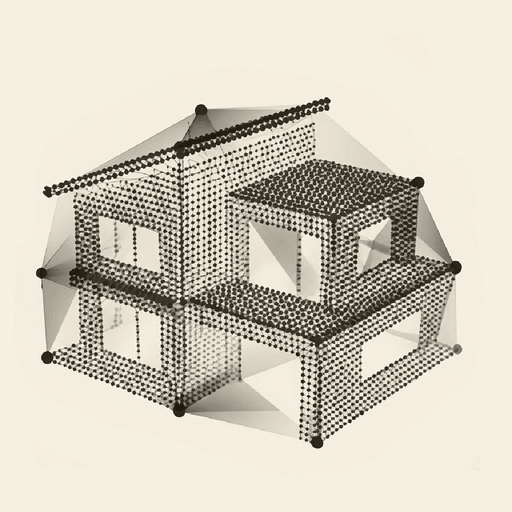
Crossing the whole home
Going from the entrance to the last cupboard without stopping, exactly as during a physical viewing.
A 360° tour links panoramas shot from fixed points. A 3D reconstruction represents the space itself: you move through it continuously, as if you were there. The difference shows in thirty seconds.
Continuous
Movement, with no fixed points imposed
True scale
Volumes restored as they are
One link
To open the tour, nothing to install
Both formats are sold under the same words, « virtual tour », although they show different things. A 360° tour shows what you see from a spot. A 3D tour shows the place.
The practical consequence fits in one sentence: in 360° you turn your head, in 3D you walk. That difference decides what a buyer really understands about the property before picking up the phone.
| 360° tour | Dalim 3D tour | |
|---|---|---|
| What is captured | Panoramic images shot from chosen positions | The shape of the space and its appearance, measured while walking |
| Movement | Jumps from one viewpoint to the next | Continuous: you go where you like |
| Sense of volume | Approximate: two panoramas do not tell you the distance between them | Direct, the space is restored at its true scale |
| Flow between rooms | Inferred: you arrive in the next room without seeing the way there | Visible: you walk the route from one room to the next |
| Capture hardware | A dedicated 360° camera, or a smartphone depending on the solution | The iPhone Pro already in your pocket |
| Measuring in the scene | Not part of the format | Measuring tool built into the viewer |
| What the buyer takes away | Accurate pictures of the property | The layout and volumes of the home |
Format comparison · Dalim, August 2026
Dalim sample tourAs soon as there are several rooms and a flow to understand. That is where a panorama runs out: it gives accurate pictures of a home you still cannot picture as a whole. For a studio or a single room to show quickly, a panorama does the job; beyond that, the essential part is missing.
For a buyer purchasing from another city, 3D is the only way to judge a volume before booking a train. And for a seller it is a concrete argument at valuation: their property will be presented in a way the other agencies do not offer.
Going from the entrance to the last cupboard without stopping, exactly as during a physical viewing.
Seeing what really separates the kitchen from the living room, instead of inferring it from two photographs.
A skirting board, a floor, the state of a window: you walk up to the material instead of zooming into an image.
The viewer's measuring tool gives distances between two points, to know whether the sofa fits.
A buyer returns to the property as often as they like, without taking an agent's Saturday.
The partner who could not attend discovers the whole home, not the listing's selection of photographs.
Open the sample tour and cross the flat from one end to the other without stopping. That is exactly what a sequence of panoramas cannot let you do.
It is a set of panoramic photographs taken from fixed positions and linked by hotspots. The visitor looks around from each of those positions and jumps between them. What they see is accurate, but they never travel the space between two shots, and the distance between rooms escapes them entirely.
Yes, in the sense that the space itself is represented, with its volumes at true scale, and not only images of that space. That is what allows free movement rather than jumping between viewpoints, judging the distance between two walls, and measuring directly in the scene from the viewer.
No, for neither format. Both open from a link on a phone, tablet or compatible computer, with nothing to install. A headset is an extra possibility, never a condition of use: the vast majority of buyers view a tour on their phone, often in the evening, between two listings.
A video imposes its route, its pace and its pauses: the viewer is stuck with the path chosen by whoever filmed it, and cannot go back to the kitchen. In a 3D tour the buyer decides where to go and how long to stay. Video narrates the property, a tour lets people explore it.
With Dalim, no: capture runs on an iPhone Pro with LiDAR, the one the agent already carries. No tripod, no dedicated camera, no professional scanner to buy. That is what makes it possible to capture at the valuation visit, during a trip that was happening anyway, rather than scheduling a separate session.
Both are shared through a link, which you can place in a listing, an email or a text message. Inserting the content directly into a portal page depends on that portal's own rules, and they do not all open them the same way, whichever format you have chosen.
The most convincing demonstration is a property you already know. Request access, capture an instruction, and judge for yourself.